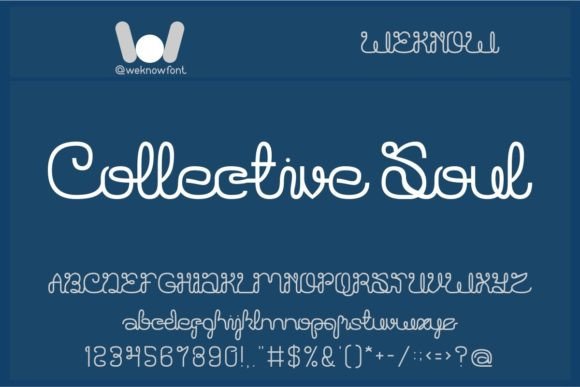
Understanding Collective Soul: A Guide to This Handwritten Display Font
In the vast landscape of typography, where clean sans-serifs and traditional serifs dominate, the search for a typeface with genuine personality is a common challenge for designers. Collective Soul enters this space as a script and handwritten display font, offering a distinct blend of artistic flair and legibility. Its design is characterized by flowing, connected letterforms that mimic the natural rhythm of handwriting, yet it maintains a clarity that prevents it from descending into visual chaos. This balance makes it a compelling option for projects that demand a human touch without sacrificing readability.
At its core, Collective Soul is crafted for impact in headlines, logos, and identity work. The font's aesthetic leans towards a warm, organic feel, which can evoke emotions ranging from nostalgia and craftsmanship to modern elegance. Unlike purely decorative scripts that prioritize ornamentation over function, Collective Soul's structure is thoughtfully designed to work across various scales. Whether used for a bold poster headline or a refined brand logotype, its character remains consistent and recognizable.
The Distinct Character of Collective Soul
What sets Collective Soul apart in the crowded field of script fonts is its nuanced approach to authenticity. Many handwritten fonts fall into two extremes: they are either overly casual, resembling quick notes, or excessively formal, mimicking calligraphic traditions. Collective Soul occupies a middle ground. Its letter connections are smooth but not overly constrained, allowing for a sense of movement that feels both deliberate and spontaneous. This quality is particularly valuable in branding, where a font must convey a specific personality consistently.
The font's versatility is another key strength. It includes a full set of uppercase and lowercase letters, numerals, and punctuation, often accompanied by stylistic alternates or ligatures. These additional glyphs provide designers with the flexibility to customize letter pairings, avoiding the repetitive look that can plague script fonts in longer words or phrases. For instance, in a logotype, swapping a standard "s" for a more swashy alternate can add a unique flourish that elevates the entire design.
Evaluating Collective Soul Against Other Font Categories
When selecting a typeface, the decision often involves choosing between broad categories. Understanding where Collective Soul fits within this spectrum is crucial for an informed choice.
Compared to Traditional Serif Fonts: Fonts like Times New Roman or Garamond offer timeless formality and high readability in body text. Collective Soul, as a display font, is not intended for lengthy paragraphs. Its strength lies in short, impactful text. If a project requires a formal, authoritative tone for body copy, a serif would be more appropriate. However, for a headline or a logo where personality is paramount, Collective Soul provides a warmth and individuality that traditional serifs often lack.
Compared to Sans-Serif Fonts: Clean sans-serifs such as Helvetica or Open Sans excel in modern, minimalist, and highly legible applications. They are the workhorses of digital interfaces and corporate communications. Collective Soul offers a direct contrast to this neutrality. It introduces humanity and artistic expression. In a design system, these two types can work beautifully together: a sans-serif for clear navigation and information, paired with Collective Soul for expressive headings that draw the eye and establish a brand's voice.
Compared to Other Script Fonts: This is where the most nuanced comparison occurs. Some script fonts are highly ornate and calligraphic, best suited for wedding invitations or luxury branding. Others are rough, gritty, and emulate a rebellious, hand-drawn style. Collective Soul's handwritten display nature generally places it in a more accessible, broadly appealing category. It avoids extreme formality or extreme grunge, making it a versatile choice for a wider array of projects, from music event posters to friendly corporate branding for a creative studio.
Practical Applications and Best-Fit Scenarios
The true test of any font is its application. Collective Soul's design makes it particularly well-suited for specific creative domains where its character can shine without compromising the project's goals.
- Brand Identity and Logos: For businesses that want to project approachability, creativity, or artisanal quality—such as a boutique coffee roaster, a indie bookshop, or a handmade goods shop—Collective Soul can form the cornerstone of a memorable logo. Its handwritten nature suggests a personal, human-centric brand story.
- Apparel and Merchandise: The font's bold presence translates well to apparel. On a t-shirt, hoodie, or tote bag, it can convey themes related to music, art, or community, resonating with audiences who value authenticity and self-expression.
- Entertainment and Media: In the realms of music, film, and gaming, Collective Soul can evoke specific genres or moods. It could be used for a band's album art, a movie poster in the indie drama genre, or a game title with a narrative-driven, artistic style.
- Digital and Social Media: As a display font, it is ideal for YouTube thumbnails, Instagram post graphics, or website hero sections. Its visual interest helps content stand out in fast-scrolling digital environments, provided it is used at a size where its details are legible.
Considering the Tradeoffs and Limitations
No font is universally perfect, and recognizing the tradeoffs of Collective Soul is part of making a wise design decision.
Readability at Small Sizes: Like most script and handwritten fonts, Collective Soul's legibility diminishes significantly when used at small point sizes, particularly in body text. The connected strokes can blur together, creating a wall of text that is difficult to read. It is essential to use it primarily for headlines, titles, or short phrases where it can be displayed at a sufficient size.
Overuse and Visual Fatigue: The very characteristic that makes it distinctive—its strong personality—can become overwhelming if overused. Employing Collective Soul for every text element in a design can create a cluttered, chaotic appearance. Effective use often involves pairing it with a more neutral font for supporting text to create visual hierarchy and give the viewer's eye a rest.
Contextual Appropriateness: While versatile, Collective Soul is not the ideal choice for every context. A law firm, a financial institution, or a medical practice typically requires a typeface that conveys precision, stability, and seriousness. In such cases, a clean sans-serif or a stately serif would be a more appropriate and trustworthy selection. Collective Soul's inherent expressiveness might undermine the required tone of authority and neutrality.
Making the Decision: When to Choose Collective Soul
Ultimately, choosing Collective Soul should be driven by the specific needs of your project and the message you wish to communicate. It is an excellent choice when your primary goal is to inject warmth, personality, and a handcrafted feel into a design. It works best when:
- Your project is centered on branding, headlines, or short-form display text rather than long-form reading.
- The desired brand voice is approachable, creative, artistic, or community-oriented.
- You have a clear plan for pairing it with a simpler, more legible typeface for body copy or secondary information.
- The application medium, whether print or digital, allows for the font to be rendered at a size that showcases its details.
If your project demands extreme formalism, ultra-minimalist aesthetics, or high-density text readability, exploring other categories of fonts would be a more practical path. The value of a font like Collective Soul lies in its ability to tell a story and evoke a feeling at a glance. By carefully evaluating your project's requirements against its strengths and limitations, you can determine if its unique character is the right tool to bring your creative vision to life.